
Marine rubber fenders, often referred to as rubber buffers, are protective devices installed on docks or ships to effectively absorb the collision energy generated between ships and docks during berthing or docking processes. They can effectively protect ships and docks, preventing damage caused by collisions. In modern port facilities and ship design, marine rubber fenders have become an indispensable safety equipment.
Based on the structure of the fender, marine rubber fenders are mainly divided into three types: D-type rubber fenders, drum-type rubber fenders, and cylindrical rubber fenders. Each type of fender has its unique design and characteristics, suitable for different application scenarios. Below, we will take a detailed look at the characteristics and advantages of these three types of marine rubber fenders.
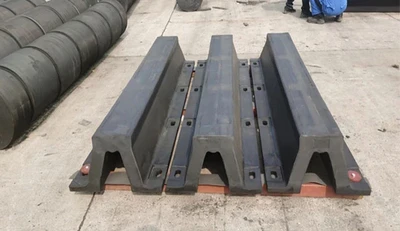
Moderate reaction force, higher energy absorption than cylindrical type: Due to the reasonable design of D-type rubber fenders, their reaction force is moderate, which can effectively absorb the energy generated by collisions, providing better cushioning effects and protecting ships and docks from damage.
Easy to install and replace: Compared to other types of fenders, D-type rubber fenders are easy to install, maintain, and replace, saving time and costs.
Smaller bottom width, especially suitable for narrow spaces: Due to their smaller bottom width, D-type rubber fenders are very suitable for use in limited spaces such as port docks, making the most of the space and enhancing safety.
Reasonable shape design, higher stress dispersion, 55% compression deformation, and long service life
High energy absorption under unit reaction force
When berthing at an angle, the performance changes are small
Large top area of the fender for installing anti-collision boards, significantly reducing the surface pressure on the ship's side, i.e., reducing the surface pressure
Plastic facing boards installed on steel structures (anti-collision boards), low friction coefficient, reducing berthing shear force.
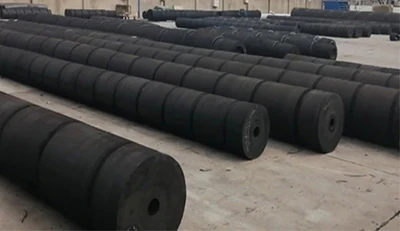
Moderate surface pressure, strong adaptability: The design of cylindrical rubber fenders allows them to provide good protection for ships of various sizes, with moderate surface pressure, and can provide corresponding protective effects based on different needs.
Reasonable energy absorption under unit reaction force: The E/R value of this type of fender is relatively reasonable, providing sufficient energy absorption while maintaining good durability.
Low energy absorption per ton of rubber, low material utilization rate: Although cylindrical rubber fenders are suitable for various environments, their material utilization rate is relatively low, and their energy absorption is slightly inferior to other types of fenders.
Easy to install and maintain, suitable for old dock renovations: Due to its simple design and easy installation, cylindrical rubber fenders are particularly suitable for the renovation and maintenance of old docks, allowing the port to quickly resume normal operations.
 Discover the Power of Cylindrical Rubber FendersOctober 17, 2024Cylindrical Rubber Fenders are the unsung heroes of the maritime world, providing essential protection for vessels as they dock and maneuver. Tonly Rubber, a leader in fender manufacturing, offers an ...view
 Co-vulcanisation and dispersion with rubber fendersDecember 16, 2024At the same vulcanisation speed, general purpose rubber is fastest with natural rubber, followed by isoprene rubber, butadiene rubber, latex polybutadiene rubber and styrene butadiene rubber. Slow vul...viewThe importance of vulcanization pressure for rubber marine fendersDecember 16, 2024The vulcanization pressure refers to the pressure per unit area of the rubber product during the vulcanization process. Except for thin-walled products such as tape, other rubber products require a ce...view
 Understanding the Value and Applications of Dock Rubber FenderOctober 17, 2024Dock Rubber Fenders are essential components for ship docking and port protection, serving as the frontline defense against impacts during vessel mooring. With the continuous growth of the maritime tr...view
 English
  français
  Español
  русский
  Türkçe