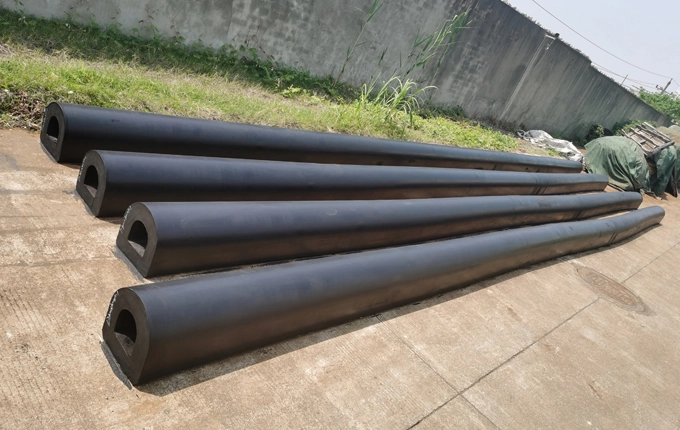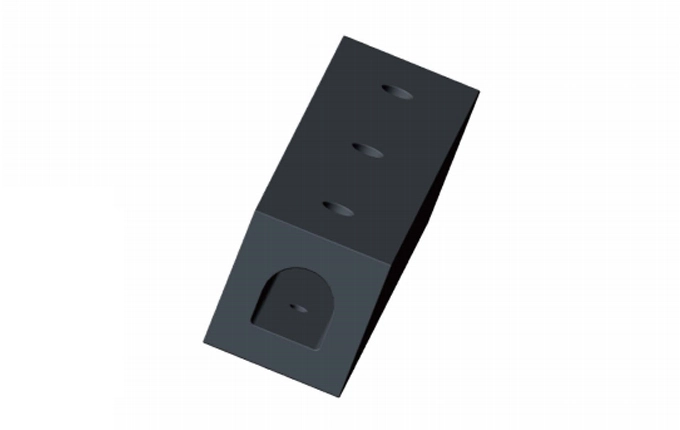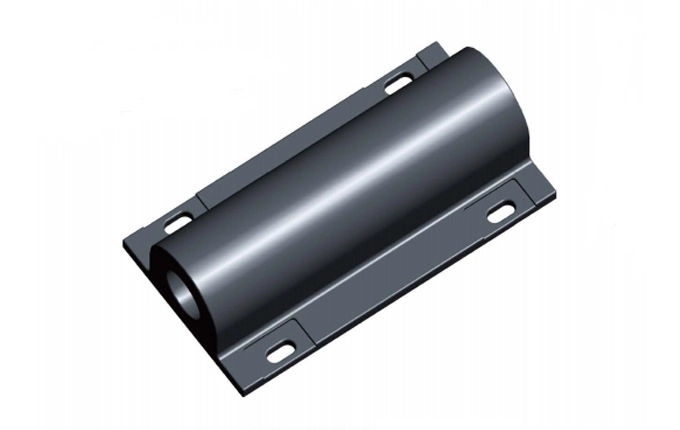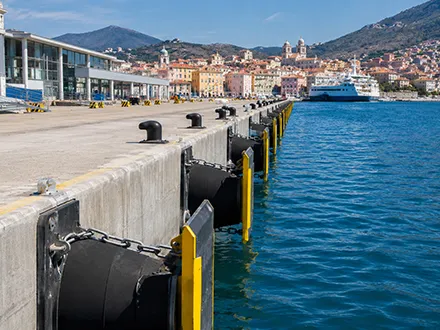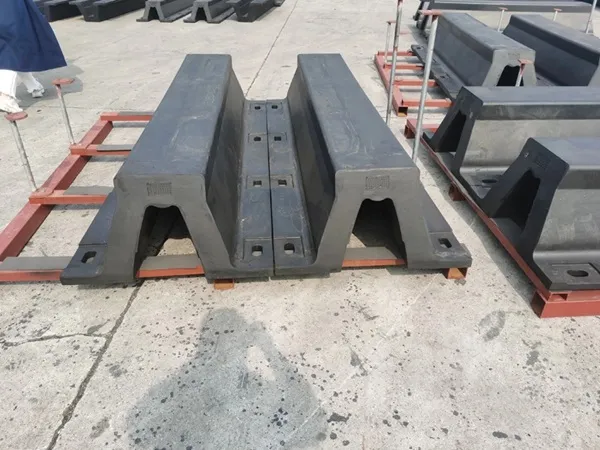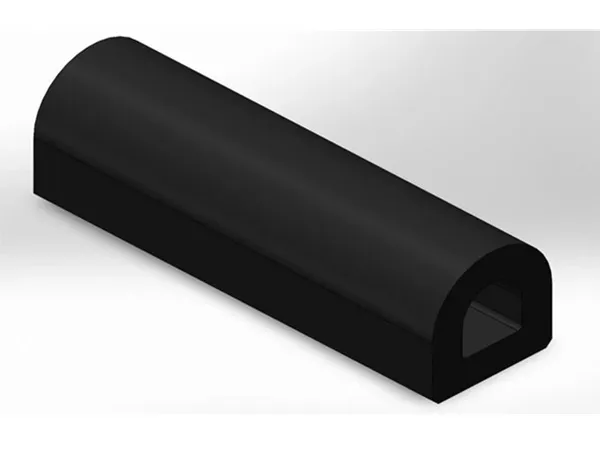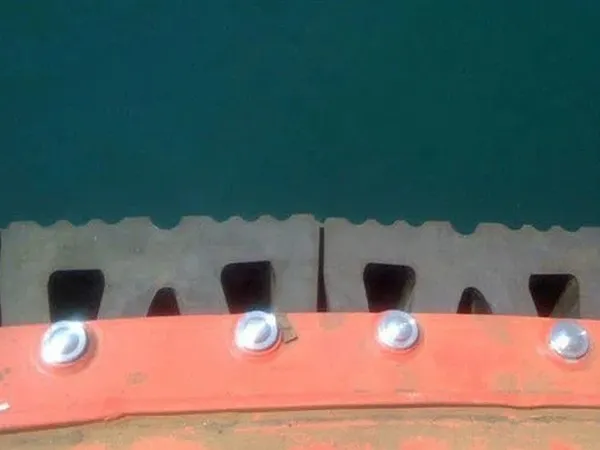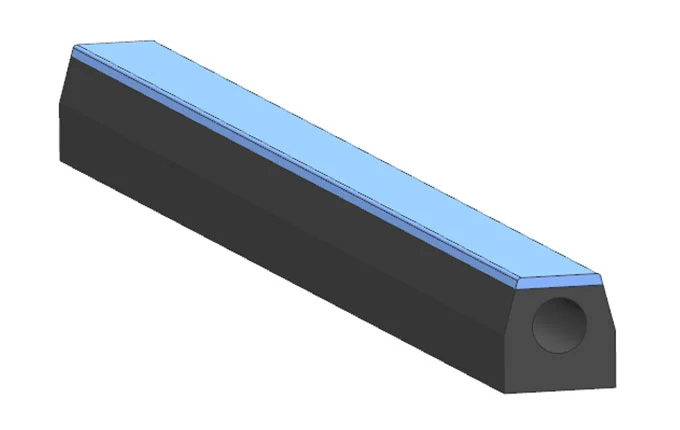
Rubber Fenders with UHMW PE Plates offer enhanced durability and reduced friction. The UHMW PE surface minimizes wear and tear on both the fender and vessel, ensuring long-lasting performance. Ideal for high-impact marine environments, these fenders provide reliable protection and easy maintenance.
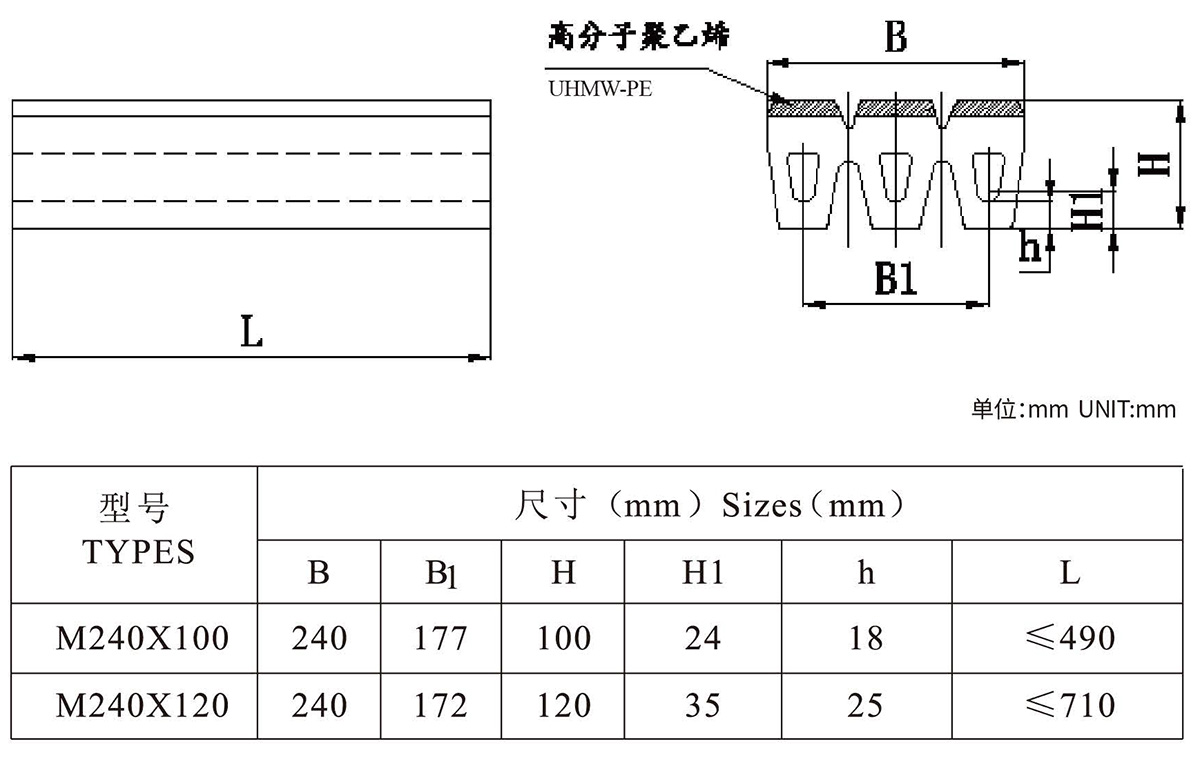
Our high-performance fender systems integrate premium grade Rubber with Ultra-High Molecular Weight Polyethylene (UHMW-PE) facing pads to ensure maximum durability. Below are the standard technical parameters and customization options available for international marine projects.
The frontal pads are the primary contact point for vessel hulls. We use virgin UHMW-PE material to guarantee a low friction coefficient and high impact strength.
| Property | Unit | Test Method | Typical Value |
| Molecular Weight | million g/mol | Viscosimetry | 4.5 – 9.2 |
| Density | $g/cm^3$ | ISO 1183 | 0.93 – 0.96 |
| Tensile Strength at Yield | $MPa$ | ISO 527 | 17 – 22 |
| Elongation at Break | % | ISO 527 | > 300% |
| Coefficient of Friction | Dynamic | ASTM D1894 | 0.10 – 0.20 (Dry) |
| Abrasion Resistance | % (Slurry Test) | ISO 15527 | < 80 (Sand/Water) |
| Hardness | Shore D | ISO 868 | 62 – 66 |
| Service Temperature | °C | Continuous | -150 to +80 |
We offer a wide range of thicknesses and configurations to suit different berthing energy requirements.
Standard Thickness: 10mm, 20mm, 30mm, 40mm, 50mm, up to 100mm.
Edge Design: Beveled edges (45° or 30° chamfer) are standard to prevent "snagging" by vessel protrusions (e.g., beltings or bolt heads).
Fixing System: Recessed fixing holes for M20–M48 galvanized or stainless steel (SS316) bolts, ensuring the bolt head is safely below the sliding surface.
Colors serve as critical visual markers for pilots and captains during the final approach to the berth.
| Color | Function / Application |
| Black | Standard UV-stabilized version with carbon black for maximum longevity. |
| Yellow | High-visibility for low-light conditions or marking hazardous pier corners. |
| Blue / White | Used to differentiate specific berthing zones or for aesthetic alignment with port branding. |
| Green / Orange | Available for specialized navigation markings on terminal leads. |
Ultra-Low Friction Coefficient (0.1–0.2): The sliding surface significantly reduces friction during vessel berthing, preventing "hull grab" and minimizing shear stress on the fender body.
Superior Wear Resistance: UHMW-PE is renowned for its exceptional abrasion resistance, outlasting traditional steel or timber facings in harsh saltwater environments.
High Energy Absorption & Low Reaction Force: The underlying rubber core absorbs massive kinetic energy while maintaining a low reaction force to protect vessel hulls.
Non-Marking & Chemically Inert: The PE plate does not leave black rubber marks on white hulls and is resistant to UV radiation, ozone, and chemical corrosion.
Impact Strength: High notched impact strength ensures the plates won't crack or shatter under extreme cold or sudden heavy impacts.
Bulk Cargo & Container Terminals: Ideal for high-frequency berthing where durability is paramount.
Ferry & Ro-Ro Terminals: Smooth sliding surfaces facilitate the quick and safe docking of passenger vessels.
Oil & Gas Jetties: Provides spark-resistant, low-friction protection for sensitive berthing operations.
Canal Entrances & Lock Walls: Perfect for guiding structures where continuous rubbing occurs.
Bridge & Pier Protection: Shields concrete structures from accidental vessel drifting.
While rubber fenders provide excellent energy absorption, they have a high friction coefficient that can "grab" a ship's hull, leading to shear force damage. Adding UHMW-PE plates reduces the friction coefficient to as low as 0.1–0.2. This allows vessels to glide smoothly along the fender, protecting the ship’s paint and significantly extending the service life of the fender system.
The standard thickness typically ranges from 30mm to 100mm. For light-duty commercial docks, 30mm–50mm is often sufficient. However, for heavy-duty container terminals or high-frequency ferry berths, we recommend 70mm or thicker pads to allow for long-term wear and tear before replacement is required.
Colors are not just aesthetic; they serve as visual navigation aids.
Yellow or Orange: Used for high-visibility to help captains identify berth corners in low-light conditions.
Black: The most cost-effective and UV-resistant option for general use.
White/Blue: Used to designate specific berthing zones for different types of vessels, improving docking efficiency and safety.
Yes, our plates are designed for easy maintenance. They are secured to the rubber fender using a bolt-on system with recessed holes. This ensures that the bolt heads (Galvanized or Stainless Steel) stay below the sliding surface to avoid scratching vessel hulls. When the plates eventually wear down, they can be replaced individually without removing the entire rubber fender unit.
Absolutely. The UHMW-PE material used by Tonly is chemically inert and has an extremely wide temperature range, performing reliably from -150°C to +80°C. It is also highly resistant to UV radiation, ozone, and sea-water corrosion, making it ideal for both arctic and tropical marine environments.
Need top-quality rubber fenders for boats and docks? Tonly offers premium, durable fenders for exceptional protection. Ideal for commercial or recreational use. Contact us for more details.

 EN
EN